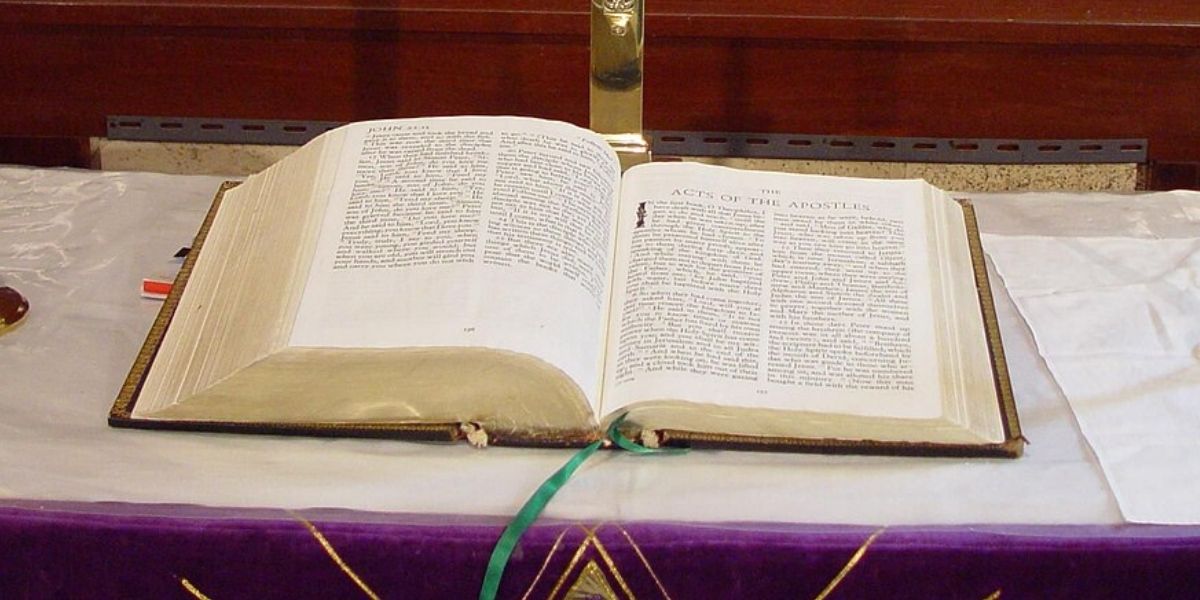
The Texas State Board of Education has approved a new required reading list that includes Bible stories and scripture passages, a move that will affect more than 5 million public school students and further expand the role of Christianity in the state’s classrooms.
The Republican-controlled board voted Friday to adopt the curriculum changes, which are scheduled to take effect in 2030.
The new requirements establish mandatory reading lists for K-12 English and literature classes and require students to read selected works “in their entirety.” The lists include traditional literary works alongside biblical stories and passages.
Bible Stories Added Across Grade Levels
Under the new standards, elementary school students will read picture-book adaptations of Bible stories including “David and Goliath” and “Daniel and the Lion’s Den.”
By fourth grade, students will begin reading passages about Jesus from the New Testament. Middle school students will study additional passages, including portions of Jesus’ Sermon on the Mount and teachings that encourage people to seek the kingdom of God.
High school students will read specific Bible passages alongside literary works such as Charles Dickens’ “Great Expectations” and Jane Austen’s “Pride and Prejudice.”
The board also approved revisions to the state’s social studies standards that place a greater emphasis on Texas and U.S. history and expand lessons on communism while reducing some instruction on global history and cultures.
Supporters Call Bible an Essential Historical Text
Supporters of the changes argue the Bible is essential to understanding Western civilization and America’s founding documents.
“We don’t have to incorporate every religious belief in our history or in our literary works, because our nation was founded on Judeo-Christian values,” Susan Perez, founder of Citizens for Education Reform, said during a school board meeting.
Brooke Mazel, a retiree from Lubbock who supported the proposal, said America should celebrate its Christian roots.
“America should celebrate our 250 years that started as a nation of unwavering Christian values,” Mazel said.
Supporters also argue the biblical passages will be taught as literature and history rather than as religious instruction.
Critics Raise Concerns About Religious Freedom
Opponents say the curriculum favors Christianity over other faiths and blurs the line between church and state.
“Kids of all faith backgrounds and no faith are served by Texas schools and they should all feel welcome in Texas schools,” Elva Mendoza of the Texas Freedom Network said. “But this is sending the message to children that one and only one religious text — a Christian one — is worthy of making this required reading list.”
Critics also argue the changes could infringe on parents’ ability to direct their children’s religious education.
“I would like to believe that my children’s constitutionally guaranteed religious freedom rights will remain intact wherever we are stationed,” Kimmie Fink, the mother of an active-duty military family stationed in Texas, told the board.
Board member Tiffany Clark, a Democrat who represents parts of the Dallas-Fort Worth area and identifies as a Christian, said many of her constituents believe “Bible lessons should be taught on Sundays.”
“Not all of us believe the same,” Clark said.
Texas at the Forefront of a National Debate
Texas has increasingly expanded the role of religion in public education in recent years.
The state already allows public schools to hire chaplains to counsel students, has approved an optional Bible-infused elementary curriculum, and requires classrooms to display the Ten Commandments.
Because Texas educates roughly one in every 10 public school students in the country, education observers say the state’s decisions often influence debates in other states.
The new reading requirements are expected to remain a flashpoint in the national debate over religion’s place in public schools.