In western Washington’s housing market, nearly $600,000 can buy you a compact 1940s Seattle home with a graffiti-covered attic bedroom — or a much newer two-story house with vaulted ceilings, a two-car garage, and trees surrounding the property in Skagit County.
For buyers trying to decide whether Seattle is still worth the premium, these side-by-side listings show just how differently the same budget stretches depending on ZIP code. And honestly, the contrast is pretty hard to ignore.
Seattle: A Small Highland Park Home With Big City Access

The Seattle listing sits in Highland Park in West Seattle and is priced at $595,000. The home itself is modest: three bedrooms, one bathroom, and 900 square feet built in 1943 on a narrow 4,477-square-foot lot.
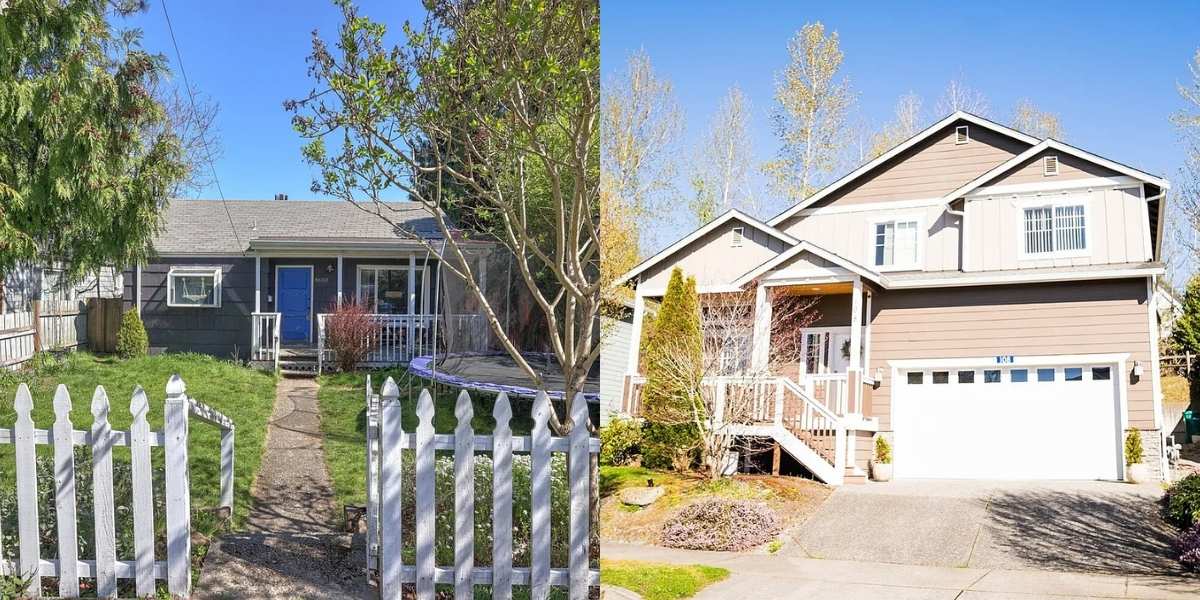
From the outside, it has some charm. There’s a white picket fence, a small front yard, and the kind of simple single-story look that feels increasingly rare inside Seattle city limits.
But inside, buyers are making compromises. The kitchen is tight, with older cabinets and dated countertops squeezed into a compact layout, though the appliances appear newer. One attic bedroom shows spray paint graffiti covering portions of the wall, making the property feel a little more “project with potential” than polished turnkey home.

Still, Seattle buyers know they’re paying for more than square footage.
The listing highlights walkability to cafes, restaurants, parks, schools, and bus routes with direct access to downtown. The detached garage has also been converted into a studio space with alley access that could potentially support a future DADU setup.
The home last sold in 2012 for $141,000. Its 2024 property tax bill: $5,161.
Click here to view the complete listing on Zillow.
Skagit County: More Space, More House, More Quiet

Now head north to Mount Vernon. For essentially the exact same price — $595,000 — buyers can get a 2013-built home with three bedrooms, three bathrooms, nearly 2,000 square feet of living space, and a noticeably calmer setting.
The difference starts immediately with the photos. Instead of a narrow urban lot, this property sits on a quiet dead-end street surrounded by greenery, mature trees, and a lush lawn. The house itself feels newer and more open throughout, with vaulted ceilings creating a brighter, airier atmosphere than the Seattle property’s tighter footprint.

The kitchen alone tells the story. There’s room to move around, stainless steel appliances, a peninsula island, and significantly more storage and prep space than the West Seattle home offers. The attached two-car garage and covered front porch also lean heavily into practical suburban comfort.
The home last sold in 2018 for $321,000. Its 2024 property taxes? Roughly the same as Seattle at $5,178.
Click here to view the complete listing on Zillow.
The Tradeoff More Buyers Are Facing
Of course, the Seattle home still offers advantages the Mount Vernon property can’t fully replicate. Living in West Seattle means quicker access to major employers, nightlife, transit, restaurants, and the kind of urban convenience many buyers still prioritize despite rising prices.
Mount Vernon offers something different: quieter streets, larger living spaces, newer homes, and a slower pace surrounded by greenery — but with a much longer distance from Seattle’s job core and entertainment hubs. For remote workers especially, those tradeoffs are becoming increasingly important.
And as western Washington home prices continue forcing difficult decisions, more buyers are asking the same question: Would you rather have location — or breathing room?