People who live in Spokane tend to have strong opinions about it.
To some, it is one of Washington’s most underrated cities: beautiful, manageable and just far enough from Seattle to avoid becoming Seattle.
To others, it is a place that looks awfully appealing until you have spent a full year there and discovered the fine print.
Across online discussion threads, Spokane residents were remarkably candid about both sides of the deal. They praised the city with genuine affection, complained about it with professional-level specificity and occasionally did both in the same sentence.
So what makes people stay—and what has them browsing Zillow somewhere else?
Here is what people say they love — and hate — about living in Spokane.
Love: A real city with nature practically in the backyard
The most consistent praise is access to the outdoors.
Residents mention hiking, mountain biking, paddling, fishing and skiing without having to surrender an entire day to traffic. One commenter in a February 2026 discussion said they could leave work and reach mountain biking trails in about 15 minutes. Others highlighted five ski areas within roughly two hours, urban whitewater, the Centennial Trail and easy day trips into North Idaho.
Spokane backs up that reputation with an unusually large park system. The city manages more than 4,100 acres of protected green space, including 87 neighborhood parks, according to Spokane Parks and Recreation.
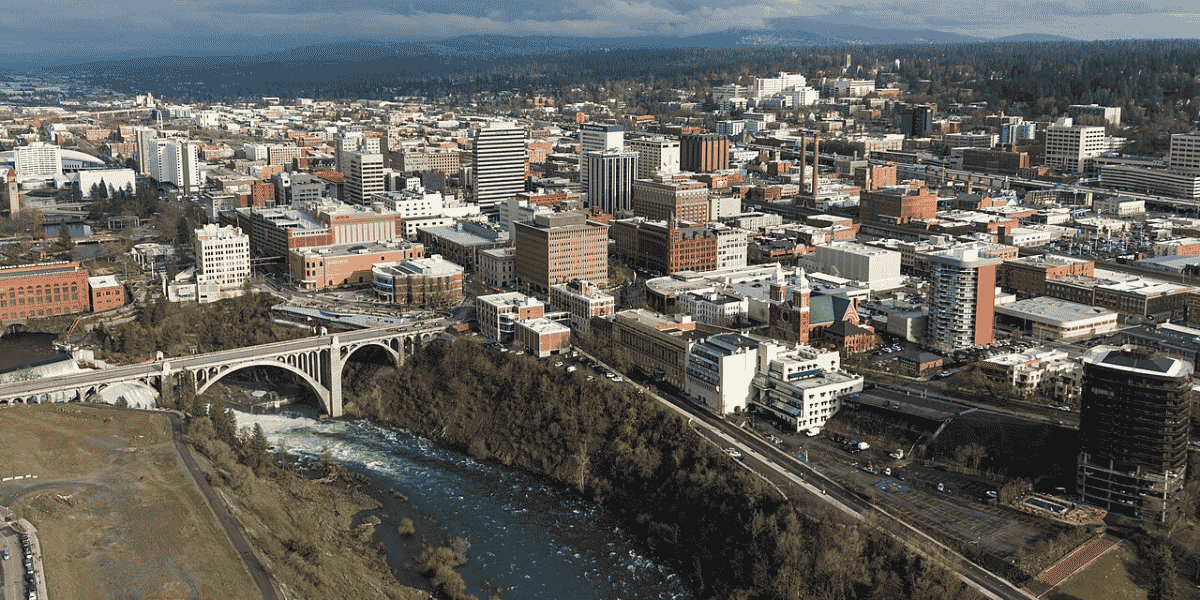
Riverfront Park places waterfalls, bridges, trails and the remnants of Expo ’74 in the middle of downtown. On the South Hill, Manito Park offers 78 acres of maintained landscape and another 20 acres of botanical gardens, including its Japanese, lilac, rose and perennial gardens.
In many cities, a waterfall downtown would be the attraction everyone tells visitors about. In Spokane, residents also insist that you feed trash to a metal goat.
The surrounding region expands the options considerably. Riverside State Park, Mount Spokane, Liberty Lake, Lake Coeur d’Alene and the trails of the Inland Northwest are all accessible without crossing a mountain pass.
That is a major distinction for Western Washington transplants. Seattle has spectacular outdoor access, too, but anyone who has attempted to reach a trailhead on Interstate 90 at 8 a.m. on a sunny Saturday understands that “nearby” is a flexible concept.
Hate: Wildfire smoke can steal part of summer
Spokane’s outdoor advantages come with an increasingly familiar catch: Some summer days are better viewed through a closed window beside an air purifier.
Wildfire smoke was one of the most emotional complaints in recent discussion threads. During a smoky stretch in August 2026, Spokane-area parents described canceling camping trips, keeping children indoors and losing weeks they had expected to spend hiking or swimming.
Several commenters said smoke had become serious enough to make them consider moving, despite otherwise loving the city.
That concern is not merely an online fixation. The Spokane Regional Clean Air Agency tracks wildfire-related fine-particle pollution and warns that smoke can cause unhealthy air quality across the region. The agency has also noted that wildfire smoke has contributed to poor grades for short-term particle pollution in national air-quality assessments.
Smoke severity varies considerably from year to year. A bad August is not guaranteed, and much depends on fires across Washington, Idaho, Oregon, Canada and the broader West.
But anyone considering Spokane because of its outdoor lifestyle should understand the irony: The season when the lakes and trails look most inviting can also produce days when public-health officials recommend staying inside.
Summer now comes with sunscreen, hydration and an app that tells you whether breathing is a good idea.
Love: Daily life is refreshingly manageable
Many residents praise Spokane less for one dazzling attraction than for the absence of big-city friction.
The U.S. Census Bureau estimates that Spokane had about 230,600 residents in 2024. Its average commute was 20.6 minutes from 2020 through 2024, short enough that a delayed left turn can still feel like a personal betrayal.
Online commenters repeatedly celebrate being able to cross town, find parking and attend events without planning their lives around congestion. Interstate 90 and Division Street certainly have their moments, but Spokane traffic is generally discussed as an irritation rather than a governing force.
Spokane International Airport receives similar affection. Residents describe it as easy to reach, easy to navigate and far less stressful than major hubs. The trade-off is that many longer trips require a connection. For frequent travelers who prefer a calm terminal over a sprawling catalog of nonstop flights, that can feel like a fair bargain.
The city’s scale also appeals to people who want concerts, restaurants, medical care, colleges and community events without the density of Seattle or Portland.
Annual traditions including Bloomsday, Hoopfest and the Lilac Festival receive frequent praise. So do Spokane Indians baseball games, the Pavilion at Riverfront Park, local art events and the city’s historic architecture.
Spokane may not keep you entertained anonymously. It will, however, give you several opportunities to run into the same person.
Hate: Housing stopped feeling cheap to local paychecks
Out-of-state shoppers can still look at Spokane housing prices and see a bargain. Many residents look at the same prices and wonder what happened to the bargain they used to have.
Zillow estimated Spokane’s typical home value at about $403,600 in June 2026, roughly unchanged from a year earlier. Its measure of average rent stood at $1,498, up 2% from the previous year.
Those figures remain well below Seattle-area prices. But affordability depends on income, not the emotional relief experienced by someone arriving from King County.
The Census Bureau put Spokane’s median household income at $70,064 in 2024 dollars. A $1,498 monthly rent would consume about 26% of that household’s gross income, before utilities. That is below the commonly used 30% affordability threshold, but the calculation assumes a household actually earns the median.
For a worker earning $40,000 a year, the same rent would take about 45% of gross income. Suddenly the Inland Northwest bargain starts looking less relaxing.
The typical Spokane home value is about 5.8 times the city’s median household income. That is not a mortgage calculation — household circumstances, down payments, interest rates and debts vary — but it helps explain why residents say home prices have escaped local wages.
In one widely discussed 2025 thread asking about “the catch” to Spokane, the most popular response was straightforward: Finding a job that supports the rent or mortgage.
That sentiment appeared repeatedly in other discussions. Remote workers and professionals arriving with higher salaries often described Spokane as comfortable. Residents working in lower-paid local positions were far more likely to describe it as unaffordable.
Spokane can still be cheaper than Western Washington while being painfully expensive for Spokane. Both statements can be true, however inconvenient that is for the moving brochure.
Hate: The job market can feel smaller than the city’s ambitions
Residents’ employment complaints are not usually that Spokane has no jobs. The city is a regional center for health care, education, government, retail and professional services.
The frustration is narrower: There may be fewer employers competing for specialized workers, and the salary attached to a local opening may not stretch as far as newcomers expect.
That makes Spokane particularly appealing to some groups — including remote workers, retirees and people entering established health care careers — while presenting more risk to someone moving first and planning to find a well-paid job later.
Online discussions repeatedly advise prospective residents to secure employment before signing a lease. That is sensible almost anywhere, but in Spokane it surfaces with the frequency of a local weather warning.
Workers in specialized fields may also find that changing employers without changing cities is harder than it would be in a larger metro area. If your industry has only a few significant local organizations, “I’ll find something else” can become a longer-term project.
Love: Four distinct seasons — with actual sunlight
Spokane residents frequently praise the seasons, particularly spring blooms, crisp autumn weather and snowy holidays.
Eastern Washington sits in the Cascade rain shadow, so Spokane receives far less precipitation than communities west of the mountains. The result is a drier climate with hot summers, cold winters and more opportunities to see the sun than Puget Sound typically provides during its annual gray residency.
For Western Washington residents tired of drizzle, Spokane can feel like someone adjusted the contrast setting.
Fall colors receive enthusiastic reviews, particularly in older neighborhoods with mature trees. Spring brings lilacs and fast-moving water through Spokane Falls. Winter offers access to skiing, snowshoeing and the aesthetic pleasure of fresh snow before anyone has driven through it.
That final condition lasts approximately seven minutes.
Hate: Winter is beautiful until you need to go somewhere
People who love snow and people who must drive up the South Hill after freezing rain are technically discussing the same climate, but they are not having the same experience.
Residents complain about side-street plowing, potholes, steep hills and the freeze-thaw cycle that can turn an ordinary intersection into an entry-level curling venue.
Spokane winters are not uniformly brutal. Some are relatively mild, and snowfall can vary dramatically. But cold snaps, persistent snowpack and icy residential streets are part of living there.
A newcomer does not necessarily need an enormous four-wheel-drive vehicle. Good winter tires, cautious driving and a willingness to accept that physics outranks confidence are more useful.
The dry climate also surprises some transplants. Spokane is greener than the word “semiarid” might suggest, but lawns, gardens and skin all notice the difference from Western Washington.
Hate: Some residents see crime and homelessness; the data show a more complicated picture
Online discussions about Spokane often turn quickly to property crime, drug use and visible homelessness, particularly downtown and along some commercial corridors.
Those concerns reflect real experiences, but the available numbers do not support the idea that crime is simply spiraling upward.
A February 2026 Spokane Police Department presentation reported 23,282 person and property crimes in 2025. That was 14.4% lower than in 2024 and 22.4% below 2019, although the department cautioned that the figures should be interpreted carefully. Spokane also launched a public dashboard in late 2025 that updates police data daily.
Homelessness remains highly visible and politically contentious. Spokane County’s federally required Point-in-Time Count identified 1,738 people experiencing homelessness on a night in January 2026, down from 1,806 in 2025. Of the 2026 total, 643 people were unsheltered.
The count covers the county and is a one-night estimate, not a complete census. It can document the scale of homelessness, but it cannot measure how often a downtown employee encounters someone in crisis or how safe an individual feels walking to a parking garage.
The fairest reading is that Spokane has genuine problems involving housing instability, addiction, behavioral health and property crime — and that the most alarming online descriptions do not always match the direction of the broader data.
Love and hate: Spokane is proudly, frustratingly midsized
One Reddit user called Spokane “the Medium Place.” Another suggested its unofficial motto should be “Spokane doesn’t suck.”
Both were meant as jokes. Both capture something real.
Residents who want endless nightlife, major touring acts every weekend, abundant international cuisine and a deep job market can find Spokane limiting. Complaints about the dating pool, restaurant variety and concerts bypassing town appear regularly.
Other residents praise the food, live music, art community and ease of getting tickets. They do not want Spokane to become Seattle. They like that a night out can involve dinner, a show and parking without requiring a spreadsheet.
The disagreement is less about what Spokane offers than about how much a person needs.
Spokane works especially well for people who value outdoor access, a manageable city, distinct seasons and a slower pace. It can be a tougher fit for smoke-sensitive households, workers in narrow professional fields, devoted big-city nightlife seekers and anyone who considers snow an administrative failure.
The people most satisfied with Spokane seem to understand the deal. It is not Seattle at a discount. It is its own place: sunnier, snowier, more relaxed, more isolated and occasionally on fire.
For plenty of residents, that trade is worth making.
Just buy the air purifier before everyone else does.