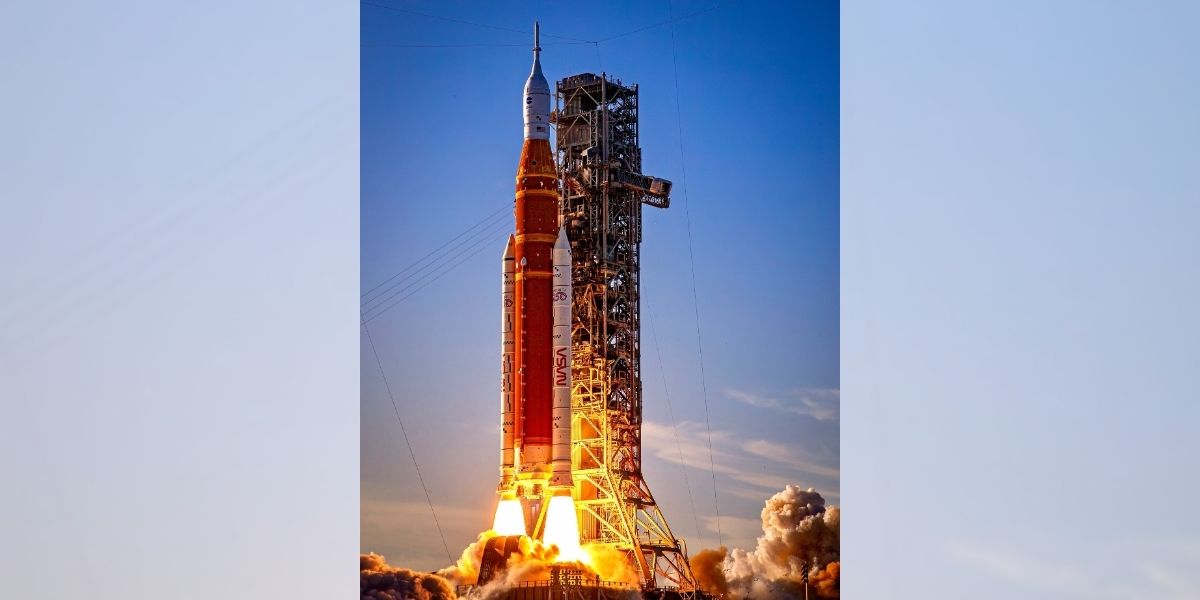
One of the most striking images from NASA’s Artemis II launch didn’t come from a photographer behind a lens—but from a camera left alone, feet from the rocket, days before liftoff.
Photojournalist Erik Kuna shared the behind-the-scenes story after capturing a dramatic shot of the Space Launch System (SLS) rocket launching from Kennedy Space Center on Wednesday, April 1.
“This is the shot you can’t get from the press site,” Kuna wrote on X.
A Camera, A Trigger, And A Risk
To get the image, Kuna placed a remote camera just a few football fields from Launch Complex 39B, leaving it exposed to the elements in the days leading up to liftoff.
The setup relied on a sound-trigger system that automatically fired the shutter when the rocket engines ignited.
“The shutter fires on sound activation,” Kuna wrote, explaining that the camera begins capturing images even before the rocket leaves the ground.
Unlike traditional photography, there’s no way to monitor or adjust the shot once it’s set.
“You set your camera up days in advance, dial in your composition, lock everything down, and walk away,” Kuna said.
The risk is part of the process. Cameras can be damaged by heat, debris, weather—or even something as simple as a bird interfering with the lens.
“You’re basically gambling a camera body every time you set one,” he wrote.
Despite those odds, the payoff can be extraordinary.
No Playbook, Just Timing
Kuna said remote launch photography is as much about improvisation as it is about preparation.
“There’s no playbook,” he wrote. “You make it up as you go.”
Photographers use a variety of methods to protect their gear, from custom-built boxes to plastic coverings, each with trade-offs between safety and composition.
Kuna said he prefers minimal protection to maintain flexibility, even if it increases the risk.
The result is a perspective that few ever see—placing viewers almost directly at the base of one of the most powerful rockets ever built.
What Is Artemis II?
Artemis II is NASA’s next major step in returning humans to the Moon.
The mission marks the first crewed flight of the Artemis program, sending astronauts on a journey around the Moon and back to Earth. It builds on the uncrewed Artemis I mission, which successfully tested the SLS rocket and Orion spacecraft.
While Artemis II will not land on the Moon, it is a critical test flight ahead of future missions that aim to put astronauts back on the lunar surface for the first time since the Apollo era.
NASA’s long-term goal is to use Artemis missions to establish a sustained human presence on and around the Moon, paving the way for future exploration of Mars.
Want more Western Washington news? Follow Puget Press on Facebook.