
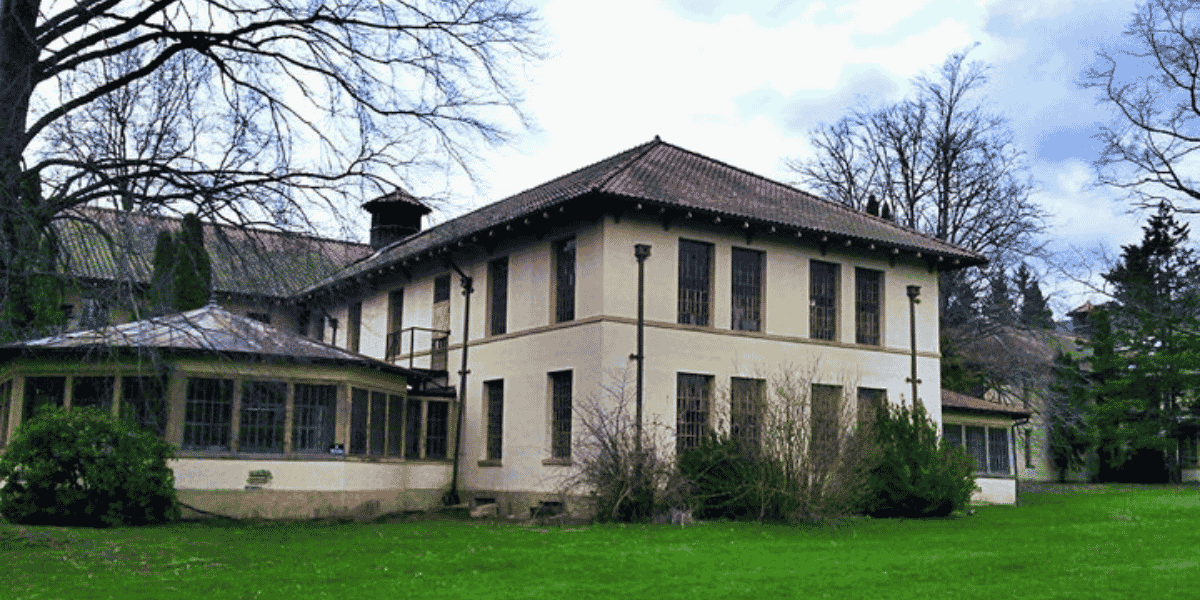
Skagit County has tulip fields, mountain views, old logging towns — and apparently quite a few residents who never got around to leaving after they died.
From the remains of a sprawling psychiatric hospital outside Sedro-Woolley to century-old theaters in Mount Vernon and Concrete, haunted places in Skagit County have accumulated decades of stories about footsteps in empty rooms, unexplained figures and things that generally behave badly after the lights go out.
Some have remarkably detailed legends. Others have little more than generations of local storytelling behind them.
Puget Press reviewed local historical records, official websites, community accounts, paranormal databases and online discussions to identify five haunted places in Skagit County that come up repeatedly.
Here’s the countdown.
5. Anacortes Museum — Anacortes

If any profession seems capable of producing a ghost, librarian has to rank pretty high.
The Anacortes Museum occupies the city’s former Carnegie Library at 1305 Eighth Street. The building opened as a public library in December 1910 after construction was funded through a $10,000 Carnegie grant, according to the City of Anacortes. It later became the home of the museum. (Anacortes Official Website)
And yes, even the city itself embraces Anacortes’ spooky side.
On its official “Haunted Tales of Anacortes” page, the city describes the old Carnegie building on a dark October day as an imposing place, complete with a creaking original door and a mural of Anacortes’ first librarian, Luella Howard. (Anacortes Official Website)
The paranormal version goes considerably further.
Haunted-location databases and a roundup published by NCW Libraries say visitors have reported unexplained footsteps, cold spots and an apparition believed to be a former librarian. (Haunted Places)
There isn’t much hard documentation behind those accounts, and HauntedPlaces.org explicitly warns that its submissions are anecdotal and largely unverifiable.
Still, a 116-year-old Carnegie library allegedly haunted by a librarian is almost suspiciously on-brand.
If somebody hears “shhh” after closing time, we’re leaving.
4. Lincoln Theatre — Mount Vernon

The Lincoln Theatre doesn’t exactly hide from its ghosts.
The historic downtown Mount Vernon theater has an entire page on its official website devoted to ghost stories — and describes the spirits said to wander its stage and hallways as “benevolent.” (Lincoln Theatre)
Built for $100,000 and opened on April 21, 1926, the Lincoln was designed by Seattle architect William Aitken as a vaudeville and silent-movie house. The restored theater still operates today at 712 S. First Street. (Lincoln Theatre)
Its ghost stories are intertwined with the history of the block itself.
Before the Lincoln existed, the property was home to early Mount Vernon settler Capt. David F. Decatur. An old Skagit County courthouse and jail stood immediately beside the property.
The Lincoln’s historical account says a concealed outdoor prisoner exercise area remains between the neighboring Matheson Building and theater, with reports that hangings once occurred there. (Lincoln Theatre)
Then there is the ghost light.
The Lincoln says the single bulb traditionally left illuminated onstage serves the practical purpose of preventing people from stumbling around a dark theater. Theater superstition gives it another job: providing a stage for resident spirits and keeping them from causing trouble in the darkness. (Lincoln Theatre)
The theater even kept its ghost light burning during its pandemic shutdown.
Of all the haunted places in Skagit County, this may be the easiest one for skeptics to enjoy. Worst case, you see a movie in a gorgeous historic theater. Best case, someone sitting three rows behind you hasn’t bought a ticket since the Coolidge administration.
3. Mt. Baker Hotel — Concrete

Concrete doesn’t merely have a haunted building.
It has enough supernatural material for an entire municipal ecosystem.
Among the town’s best-known legends is the Mt. Baker Hotel on Main Street.
Concrete Ghost Walk founder Valerie Stafford told Cascadia Daily News in 2025 that the hotel was one of the first places she found when she began researching Concrete’s paranormal reputation roughly two decades ago. (Cascadia Daily)
The story centers on a young girl who, according to local legend, was killed by her mother and can now be seen through an upstairs window.
Stafford told the newspaper that guests had more recently reported being awakened around midnight by the sound of a little girl singing in the hallway.
That doesn’t mean the legend’s underlying story has been independently established as fact. Stafford herself is refreshingly candid about the line between history and theatrical storytelling.
“We’re assuming these characters are still with us for various reasons,” Stafford told Cascadia Daily News, “whether that’s a supernatural thing, or whether we’re just making it up because it’s fun to talk about.” (Cascadia Daily)
Today, the Mt. Baker Hotel remains an operating lodging property at 45951 Main Street. (Mt.Baker Hotel)
So unlike several haunted places in Skagit County, this is one where you can potentially spend the night.
Whether you actually want to wake up to a child singing outside your room at midnight is between you and your travel companion.
2. Concrete Theatre And Downtown Concrete — Concrete

Picking one haunted building in Concrete is a little unfair. The whole downtown has gotten involved.
Stafford, who owns the historic Concrete Theatre with her husband, Fred West, began investigating the town’s ghost stories after experiencing ghost tours elsewhere.
She told Seattle City Light that she started going door-to-door along Main Street asking business owners whether they thought their buildings were haunted.
The response surprised her.
“I was amazed by how many people told me that they had had some paranormal experience or had at least heard stories,” Stafford said. “However, nobody was scared.” (Powerlines)
Those conversations eventually became the Concrete Ghost Walk, which launched in 2006 and has grown into an annual October tradition.
The theater itself is a natural headquarters.
The Concrete Theatre opened at its current location in 1923 and hosted silent movies, early “talkies,” vaudeville performances and even boxing matches. Stafford and West bought and restored the building in 2009 before reopening it in 2010. (Concrete Chamber of Commerce)
Stafford has said spending time alone inside changed her own attitude toward the paranormal.
“I am not particularly susceptible to paranormal experiences,” she told Seattle City Light. “I don’t know what to think about people coming back to haunt an area, but after spending time in the theatre alone, I have come to believe.” (Powerlines)
The ghost stories aren’t confined to the theater.
Concrete’s annual tour winds through downtown streets and alleys while actors portray figures from the community’s past. The stories draw heavily from the town’s genuinely rough history as a center for logging, mining and cement production.
The tradition is still going strong. The 2026 Concrete Ghost Walk is scheduled for Oct. 3, 10, 17 and 24, beginning at the Concrete Theatre. Organizers describe it as a mixture of history, mystery and local legend rather than an attempt to prove the paranormal. (Concrete Chamber of Commerce)
That distinction matters.
The best haunted places in Skagit County tend to be interesting even after you remove the ghosts. Concrete has enough boomtown history, industrial accidents, colorful characters and old buildings to carry the story on its own.
The alleged spirits are just extra seasoning.
1. Northern State Hospital — Sedro-Woolley

There wasn’t much competition for No. 1.
Search online for haunted places in Skagit County, and Northern State Hospital appears again and again.
The former psychiatric hospital near Sedro-Woolley has become one of Washington’s better-known alleged paranormal locations, with stories involving shadowy figures, unexplained voices, a little girl carrying a red ball and a mysterious nurse.
But Northern State’s actual history deserves more attention than the ghost stories.
The institution traces its beginnings to 1909, when Washington established what was initially called the Western State Hospital Farm for the Harmless Insane. Patients from Western State Hospital near Tacoma were brought north to clear heavily forested land and construct buildings. (Northern State Hosp.)
Northern State eventually became an enormous, largely self-sufficient institution.
Patients worked its farm, tending livestock, growing vegetables, maintaining orchards and producing food. Skagit County says the operation became productive enough to supply surplus food to other Washington institutions. (Skagit County)
The hospital closed in the 1970s.
Today, portions of the former property have been repurposed. Skagit County owns the 726-acre Northern State Recreation Area, which includes trails, fields and surviving agricultural structures from the hospital farm. (Skagit County)
And that’s where the internet takes over.
Visitors have posted stories for years about feeling watched, hearing voices and seeing figures around the property.
In one Reddit discussion, a person who said they grew up near Sedro-Woolley and had relatives connected to Northern State recalled hearing throughout childhood that the property made people feel as though they were being watched. (Reddit)
Another Reddit user who visited Northern State was considerably less impressed.
“I had zero luck at Northern State although it’s a lovely park,” the commenter wrote in a Washington ghost-hunting discussion. (Reddit)
And that may be the most scientifically honest ghost review ever written.
Northern State’s paranormal reputation has become strong enough that there’s an important practical warning attached to it: don’t break into the buildings.
Skagit County specifically tells visitors not to enter historic structures, and park hours run from dawn to dusk. The Northern State historical project likewise says visitors are welcome along designated areas during daylight hours but entry into buildings is prohibited. (Skagit County)
In other words, ghost hunting is not a permission slip for trespassing.
Why Skagit County Has So Many Ghost Stories
There is a pattern connecting many haunted places in Skagit County. They’re old.
The Anacortes Museum’s building dates to 1910. Northern State’s origins go back to 1909. Concrete Theatre opened in 1923. Mount Vernon’s Lincoln Theatre followed in 1926.
More importantly, they’re buildings and communities where generations of people worked, lived, struggled and died.
Concrete’s ghost stories grew directly out of residents sharing memories about historic buildings. Stafford told Seattle City Light that locals generally didn’t describe their alleged ghosts as threatening. Instead, they viewed them almost as another feature that came with occupying an old building. (Powerlines)
That’s probably why Skagit County’s best ghost stories work even if you don’t believe a word of the paranormal part.
They preserve pieces of local history.
A forgotten psychiatric hospital becomes something people research. A century-old theater gets another audience. Stories about miners, loggers, librarians, patients and business owners get repeated by people who otherwise might never have learned their names.
Maybe there are ghosts wandering around Skagit County.
Maybe old buildings simply creak, human brains are spectacular pattern-recognition machines and walking around an abandoned hospital after dark is an objectively terrible way to calm your imagination.
Either way, the stories aren’t going anywhere.
And if you’re standing alone inside a 100-year-old theater when something moves backstage, you can explain the science to it yourself.

Want more local news? Follow Puget Press Skagit County on Facebook.