Snohomish County has all the raw materials for a first-rate ghost story: mining towns, weathered hotels, old theaters, Victorian mansions and enough rain to make practically any window look suspicious after midnight.
The most famous haunted places in Snohomish County also happen to contain some genuinely fascinating local history. The ghosts remain unconfirmed. The fires, fortunes, renovations and remarkably persistent rumors are another matter.
This ranking considers the strength of each location’s history, the prominence of its supernatural reputation and the number of times its stories have resurfaced. It is not a scientific measurement of spectral occupancy. There is, regrettably, no county ghost census.
5. Rucker Mansion, Everett

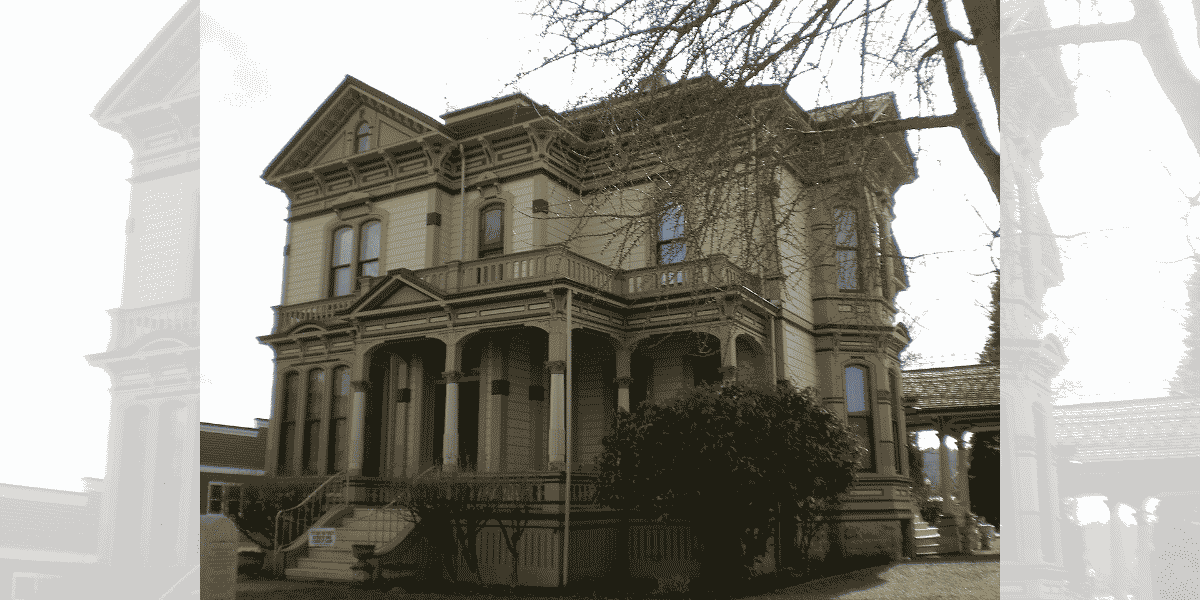
High above Port Gardner Bay at 412 Laurel Drive, the Rucker Mansion looks as though it was designed specifically to acquire a ghost story.
Construction began in 1904 for Jane Morris Rucker, her sons Wyatt and Bethel, and Bethel’s wife, Ruby. The family had accumulated its fortune through Everett banking, real estate and lumber investments.
The four-story, 13,000-square-foot residence included six bedrooms, five fireplaces, two kitchens, a billiard room, a ballroom and an elevator installed for Jane, who used a wheelchair. Its design blended Italian Villa, Queen Anne and Georgian Revival styles, according to Historic Everett.
That elevator is an important detail because it undermines the mansion’s most sensational legend.
The familiar story claims Jane died after jumping from an upstairs window in 1907. Later residents supposedly heard her playing the piano or saw her near the window from which she fell.
Historical records tell a less theatrical story. Jane’s death certificate lists stomach ulcers and aortic regurgitation as her causes of death. The mansion’s National Register documentation also notes that she was in failing health and used a wheelchair.
In other words, the alleged piano music is part of Everett folklore, but the suicide story attached to it appears to be false.
That does not make the mansion less interesting. It makes it a useful example of how ghost stories evolve—one dramatic detail gets repeated, embellished and eventually treated like history.
The Rucker Mansion is a private residence. Admire it from public areas of the Rucker Hill neighborhood, but do not enter the grounds, approach the windows or ask the owners whether Jane takes requests.
4. Bush House Inn, Index

The Bush House Inn stands at 308 Fifth Street in Index, surrounded by steep Cascade walls and within earshot of the railroad. If a mountain hotel were going to star in a ghost story, this one would have excellent representation.
The inn dates to 1898, when Index’s mining economy was gathering momentum. The Great Northern Railway had reached the area earlier in the decade, and the nearby Sunset Mine began producing copper in 1897.
Bush House became one of five hotels serving the small but busy town. University of Washington mining students stayed there in the early 20th century, and the building remained a community gathering place as Index shifted from mining toward outdoor recreation.
Time nearly finished what mining’s decline had started. The inn closed in 2002, suffered storm and vandalism damage, and was later placed on the Washington Trust for Historic Preservation’s endangered-properties list.
New owners began an extensive rescue in 2011. Restored guest rooms reopened in 2021, and the inn now offers 10 rooms, a cottage and event spaces, according to the Bush House’s official history.
Then there is Annabelle.
According to local legend, Annabelle was staying at the hotel when she received word that her fiancé or husband had died in a mining accident. The story says she took her own life in Room 9, only for the miner to return alive. Some versions add that he then died by suicide as well.
It is a properly devastating ghost story. It is not, however, a documented biography.
The legend’s details vary considerably—including Annabelle’s name, marital status and what supposedly happened to the miner. The inn’s detailed historical timeline does not identify her, and readily available historical sources do not establish that the deaths occurred.
Paranormal accounts nevertheless associate the property with unexplained perfume or cigar smoke, disturbed furniture and an uneasy feeling around the upper floors. Old buildings also produce drafts, settling noises and wandering smells with impressive efficiency.
Bush House is open for overnight lodging, subject to availability. Stay because it is a beautifully restored piece of Index history. Consider any supernatural roommate an unadvertised amenity.

3. Stanwood Hotel and Saloon, Stanwood

The Stanwood Hotel and Saloon at 26926 102nd Avenue NW has spent more than a century welcoming travelers, serving meals and giving ghost hunters something to discuss over the player piano.
Originally called the Hotel Cottage Home, it was operating by the early 1900s. A 1909 advertisement described an expanded, newly furnished hotel with 33 rooms, electric lights and meals available at all hours.
The location was once advantageous because the Pacific Highway passed nearby. When the route shifted toward East Stanwood before 1922, the hotel suddenly found itself away from the main stream of traffic.
A bar was installed following the repeal of Prohibition in 1933. Later owners preserved an elaborate mahogany back bar acquired from Stanwood’s demolished Palace Hotel, according to the Stanwood Area Historical Society.
Leonard and Marilyn Guthrie began restoring the property in the 2000s. When five renovated guest rooms reopened in 2012, employees and paranormal investigators were already swapping stories.
Investigators claimed to record what sounded like children’s voices in an empty hallway. Other accounts described doors moving, footsteps and a woman appearing near an upstairs window.
Marilyn Guthrie gave the legends exactly the right amount of oxygen in a Herald report. She said she documented what employees told her but emphasized that the building was not a frightening place.
That distinction matters. The haunting is part of the hotel’s modern folklore, while the restoration and business history are documented. A recorded sound may be intriguing, but it is not an employee roster from the afterlife.
The Stanwood Hotel and Saloon remains in business. Contact the property directly for current room availability, prices and saloon hours rather than relying on older travel articles.
2. Historic Everett Theatre, Everett

Some theaters have understudies. The Historic Everett Theatre apparently has “Smilin’ Al.”
The theater opened at 2911 Colby Avenue in 1901, when traveling productions, vaudeville performers and early motion pictures competed for Everett audiences.
Its stage hosted an extraordinary list of entertainers. George M. Cohan appeared in 1904. Al Jolson performed there in 1906 and returned in 1915. A young Lon Chaney danced in a musical-comedy company at the theater in 1911, years before becoming one of silent film’s most recognizable stars.
A fire badly damaged the building in December 1923. It reopened in August 1924 and continued operating as downtown Everett’s entertainment business changed around it.
The auditorium was divided into three screens in 1979, and the building closed in 1989 after its heating system failed. Community preservationists reopened it for live performances in 1993.
That reopening period also gave Everett one of its most enduring apparitions.
According to a 1993 report later recounted by The Daily Herald, several people saw a smiling, gray-haired man inside the theater. The figure became known as Smilin’ Al, partly because Jolson had performed there.
The nickname is catchier than the evidence. No reliable account identifies the figure as Jolson, and a veteran theater is naturally full of odd acoustics, backstage movement and lighting effects. It is also a workplace where people regularly dress as somebody else, which complicates paranormal identification.
Still, shadowy figures, moving doors and temperamental lights have remained part of the building’s lore. The theater has even hosted paranormal investigations, proving that a good venue knows how to diversify its bookings.
The renamed New Everett Theater continues presenting concerts, comedy and community events. Admission requires a ticket to a scheduled event; it is not an open-access ghost-hunting site. Check the current event calendar before visiting.
1. Oxford Saloon, Snohomish

Of all the haunted places in Snohomish County, none has embraced its supernatural reputation quite like the Oxford Saloon.
Located at 913 First Street in downtown Snohomish, the building began as one of merchant Arthur Blackman’s stores. Historical sources place its construction around 1890, although the saloon’s own materials give conflicting dates, including 1890 and 1900.
The documented history is colorful enough. Builder John S. White created the large false-front store for approximately $5,000. During Prohibition, the building housed the Oxford Pool Room. It did not legally operate as a drinking establishment until around World War II.
The folklore adds a rumored bordello upstairs and several permanent guests who allegedly stopped paying their tabs decades ago.
The best-known is “Henry,” described as a police officer or bouncer killed while breaking up a fight near the basement stairs. Visitors and employees have attributed footsteps, touches and restroom encounters to him.
Upstairs stories involve a woman called Kathleen or Katherine, another called Amelia, and a man in a bowler hat. Accounts disagree about who the women were and how Amelia allegedly died. Those inconsistencies are a good reason to treat the characters as folklore rather than confirmed former residents.
Paranormal groups investigating the building since 2005 have reported unexplained voices, malfunctioning keys, moving furniture and figures in photographs. None of that constitutes independently verified evidence, but it has helped make the Oxford the county’s best-known paranormal destination.
The physical setting does plenty of work on its own. It is an old commercial building with a basement, upstairs rooms and more than a century of remodeling—excellent conditions for echoes, drafts, plumbing noises and a lively imagination.
The Oxford remains a working restaurant, bar and live-music venue. Its official website currently lists daily operating hours, with the basement Cellar Pub open on Friday and Saturday nights.
Visit for a meal or a performance, respect employee-only areas and remember: ordering “spirits” does not entitle you to demand proof of them.
Why Snohomish County Keeps Its Ghosts
The appeal of haunted places in Snohomish County has less to do with proving an afterlife than with keeping local history in circulation.
A ghost story gives people a reason to ask who built a mansion, why a hotel survived, what happened to a mining town or how a theater escaped demolition. The supernatural details may shift with every retelling, but the buildings remain tangible links to the county’s industrial, commercial and cultural past.
Believe the legends, doubt them or keep one foot politely in each camp. Just verify the history, respect private property and never let a dramatic death scene get in the way of an actual death certificate.