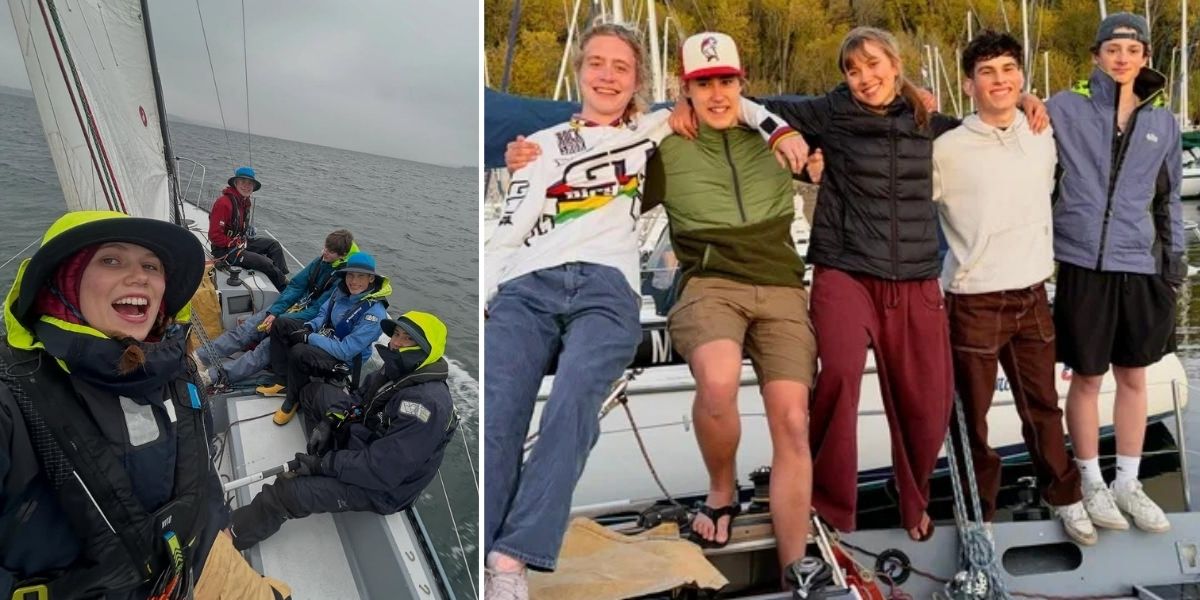
Five Seattle high school students are preparing to take on one of North America’s most grueling boat races — a 750-mile journey to Alaska with no engine, no support, and no margin for error.
The team, known as Darwin’s Interns, plans to compete in the 2026 Race to Alaska, a rugged, self-supported race that stretches from Port Townsend to Ketchikan, Alaska.
The group — Isadora Ford, Henry Thomas, Odin Bjorklund, Oliver Laskowski, and Teddy Dodd — will make the journey aboard a 27-foot sailboat, relying only on wind and human power to reach the finish line.
“They’re out to test the limits of hull integrity, interpersonal tension, and how long you can live on sour candy and ego,” reads the team’s bio.
The race is widely known for its extreme conditions and minimal rules. There are no engines allowed, no support crews, and no guaranteed rescue. Teams must navigate open water, strong currents, and remote wilderness on their own, often far from help.
“Thankfully we are a tight-knit crew with a lot of passion for adventure and love for one another,” they said.

The course includes two stages, beginning with a qualifying leg across the Strait of Juan de Fuca before continuing north through coastal waters shaped by glaciers, passing through tidal rapids and isolated shoreline.
“These are the ancestral waters of the Coast Salish, Tlingit, Haida, and many others—paddled by native canoes since time immemorial, sailed by traders and gold rush steamers, and still wild today,” organizers said.
“Rescue is hours—sometimes days—away. Out here, self-reliance isn’t a virtue. It’s survival.”
Winners receive $10,000, while second place earns a symbolic prize — a set of steak knives. Most teams, however, are simply aiming to finish.
Darwin’s Interns will compete aboard “Nomad,” a 27-foot Santa Cruz sailboat with a history in the race, having been used by previous teams in past Race to Alaska events.
“Some of these barely-housebroken sailors already survived a tour on her, and the rest are here to add new layers to the boat’s rich, pungent history,” the team wrote.

Preparing for the race comes with significant costs, including boat repairs, moorage, safety gear, and food. They’ve launched a GoFundMe campaign to help out.
“We have lots of expenses continually mounting and every dollar will help,” the team wrote.
Dozens of teams are expected to compete in the 2026 race, each bringing their own strategy, vessel, and tolerance for hardship.
The event has become known as much for its unpredictability as its endurance, with some teams finishing in just a few days while others never complete the course.
Each crew must apply and be approved by a vetting team that reviews experience and preparedness before granting entry into the race. Applications are often rejected if teams aren’t deemed capable of completing the journey safely.
“These waters are serious business, and we’re not joking that we don’t have safety boats,” organizers said.
But that danger isn’t stopping this group of adventurous teens. Asked what advice they plan to ignore, they didn’t hesitate: “stopping and having a toilet.”
Those interested in supporting Darwin’s Interns can donate via GoFundMe, and follow their journey on Instagram.
Want more local news? Follow Puget Press Jefferson County on Facebook.