Lake Stevens occupies an interesting place in Snohomish County.
It’s no longer the small town many longtime residents remember, but it’s not quite a full-fledged suburb either.
To outsiders, it’s known for its namesake lake, newer housing developments, strong schools, and relative affordability compared to places closer to Seattle and Bellevue.
For families priced out of King County, Lake Stevens often shows up on the shortlist. The promise is appealing: larger homes, bigger yards, access to outdoor recreation, and a quieter pace of life without completely leaving the Puget Sound region behind.
But what’s it actually like living there?
That question was recently posed to local residents, and while opinions varied, a few themes emerged again and again.
Most people agreed Lake Stevens is safe, family-friendly, and beautifully situated between the mountains and the city. They were much less enthusiastic about the traffic.
The Trestle Lives Rent-Free in Everyone’s Head
If you ask Lake Stevens residents about the city’s biggest drawback, don’t be surprised if they answer before you’ve finished the question.
“The trestle is a nightmare.”
“The trestle traffic is atrocious.”
“THE TRESTLE will be your worst most hated enemy.”
The bridge connecting Lake Stevens to Everett has become something of a shared community trauma.
Residents described commutes that can range from reasonable to soul-crushing depending on timing, weather, accidents, and seemingly random acts of traffic chaos.
“Trestle could take 2 minutes to get to Everett or 45 depending on how stupid the people driving on it at that point in time are,” one resident wrote.
Another said commuting to Seattle or Bellevue requires serious consideration.
“Give yourself a year of it and either move or find closer work. It is not a normal commute.”
Several residents who work in Seattle reported commute times ranging from an hour to nearly two hours during peak periods.
Others said the situation has improved somewhat thanks to remote work, but nobody claimed the commute was enjoyable.
A Family Town With Good Schools
If traffic is the biggest complaint, schools are probably the biggest selling point.
Residents repeatedly cited the school district as one of the primary reasons families choose Lake Stevens.
“Great school system.”
“School district.”
“Pretty nice place to raise a family.”
Those comments align with available data. Lake Stevens School District holds an A- rating from Niche, which evaluates districts based on academics, teachers, college preparation, and other factors.
Several residents described neighborhoods where children still ride bikes, play outside, and know the neighbors.
“I have a large lot and a neighborhood where I feel comfortable letting my kids explore and play with neighbor kids without super close supervision,” one resident wrote.
Not everyone was completely satisfied. A few residents described schools as overcrowded and expressed concerns about support services. But overall, the district earned far more praise than criticism.
More House For Your Money
One reason Lake Stevens continues attracting newcomers is housing.
While few residents described housing as cheap, many noted it remains more attainable than Seattle, Bellevue, or much of the Eastside.
According to housing data, owner-occupied homes in Lake Stevens have a median value around $635,000, while recent home sales have generally fallen between roughly $695,000 and $758,000.
That’s still expensive by national standards, but significantly less than many communities closer to Seattle.
One resident noted Lake Stevens has become one of the few places in Snohomish County where buyers can still find larger homes on sizable lots without venturing far into rural Washington.
Others appreciated getting “a lot more house and yard for our money.”
The tradeoff, many said, is distance.
Don’t Miss: He-Man Co-Creator, Lake Stevens Resident Roger Sweet Dies At 91 – Fans Rally Around Widow’s GoFundMe

The Lake Is the Star
While residents argued about traffic, politics, restaurants, and roundabouts, nearly everyone seemed to agree on one thing.
The lake is genuinely great.
“It’s beautiful year round.”
“The lake is relatively accessible and fantastic.”
“It’s nice to live by the lake, to walk by, jump in.”
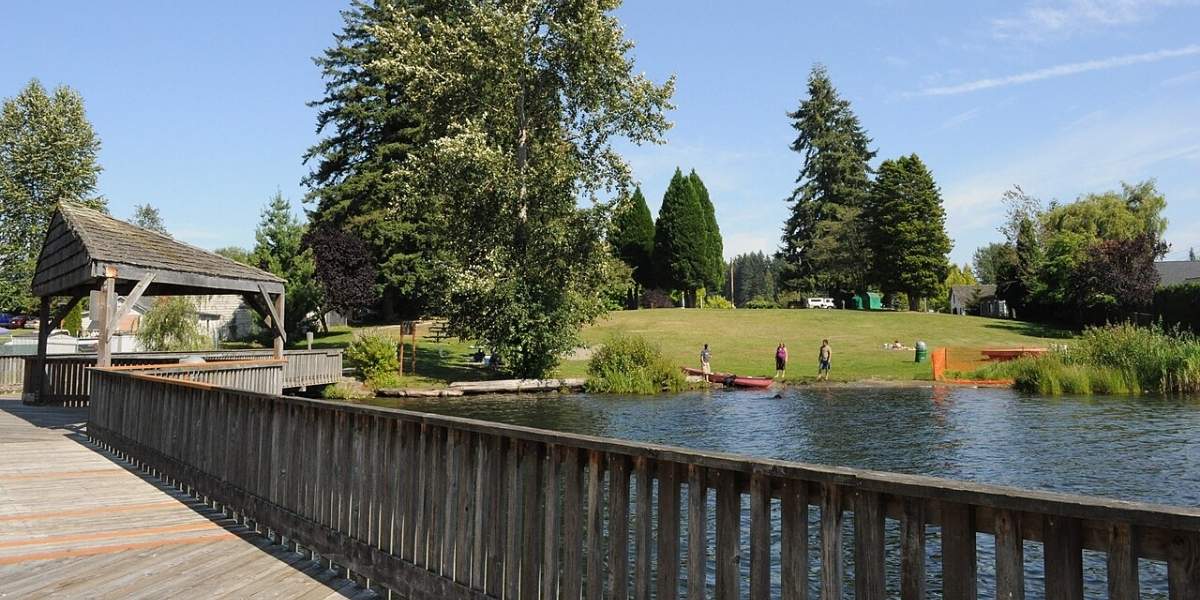
Many residents cited recreation as one of the city’s biggest advantages. Lake Stevens offers boating, swimming, fishing, and waterfront parks, while the Cascade foothills and Mountain Loop Highway sit a short drive away.
“You’re on the doorstep of the mountains,” one resident wrote.
Another highlighted the ability to beat Seattle crowds to hiking trails and trailhead parking lots.
Several residents described the location as one of the city’s strongest assets: close enough to urban amenities, but much closer to outdoor recreation.
The Roundabout Debate
No discussion of Lake Stevens would be complete without mentioning the roundabouts.
Residents brought them up constantly. Some hated them. Others defended them passionately.
“How do you feel about roundabouts and people who don’t know how to drive?” one resident joked.
Another offered a more direct assessment: “Don’t move here, too many roundabouts!”
That same resident quickly clarified they were joking and argued the city actually needs more roundabouts.
The real issue, many suggested, isn’t the traffic circles themselves. It’s the drivers.
“Yes the roundabout sucks but there are streets around them,” one resident wrote.
Chain Restaurants, Costco, and Tuesday Night America
One of the more colorful descriptions came from a resident who compared Lake Stevens to “everything you would want on a Tuesday night in middle America.”
Several residents described the city as comfortable, practical, and predictable.
You need groceries? No problem.
Need Costco? Got it.
Need Target? Also covered.
Looking for a thriving downtown restaurant scene? That’s where opinions became less enthusiastic.
“There are no good restaurants.”
“The restaurant options are awful.”
“LS is just chain garbage.”
Others weren’t quite that harsh but acknowledged that dining options tend to skew heavily toward chains, pizza places, and fast food.
Multiple residents said they often head to Snohomish, Everett, Bothell, or elsewhere when looking for a memorable night out.
One longtime resident described Lake Stevens as “an amorphous blob of houses and strip malls” with little sense of downtown identity.
Several others echoed similar sentiments, saying the city feels more like a collection of neighborhoods than a traditional town center.
Community Feel Depends on Who You Ask
Residents were surprisingly divided when discussing community.
Some described Lake Stevens as welcoming, safe, and friendly.
“Our neighbors are amazing.”
“The people are kind and friendly.”
“Lake Stevens as a community is really pretty awesome.”
Others reported having the opposite experience.
One resident said they had encountered “a strange sense of entitlement” among some residents.
Another described the city as a mixture of conservatives, liberals, newcomers, longtime locals, blue-collar workers, professionals, and everyone in between.
“It’s a weird melting pot,” one resident wrote.
What emerged wasn’t a clear political or cultural identity, but rather a community still figuring out what it wants to become as growth continues.
So What’s It Really Like Living in Lake Stevens?
For most residents, Lake Stevens comes with a simple proposition.
You get more house, more yard, better access to nature, and generally strong schools than you might find closer to Seattle.
In exchange, you accept traffic, roundabouts, limited restaurant options, and a commute that can test even the most patient driver.
Home to roughly 41,000 residents, Lake Stevens appears to be growing into something larger than the small town it once was. Whether that’s a good thing depends on who you ask.
But if there was one observation nearly everyone could agree on, it might be this:
The lake is beautiful. The schools are solid. And if there’s an accident on the trestle, you’re probably going to be late.