In a quiet building in the Arizona desert, more than 200 dead people are patiently waiting to be brought back to life.
They aren’t buried. They aren’t cremated.
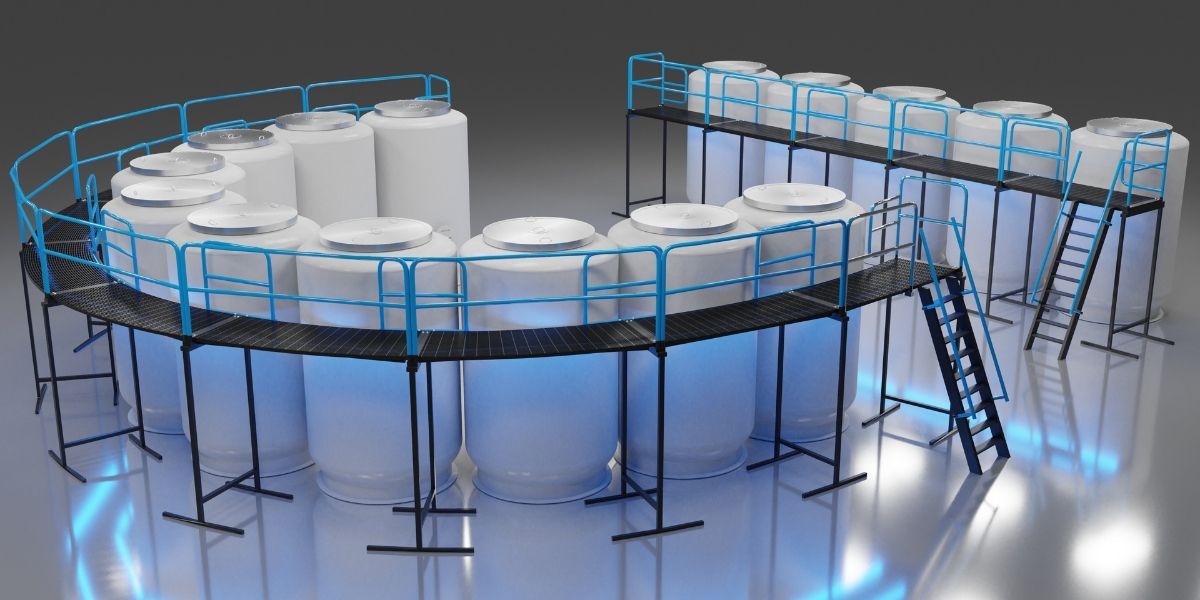
Instead, their bodies — and in some cases, only their heads — are stored upside down inside giant steel containers filled with liquid nitrogen, preserved at temperatures below minus 300 degrees Fahrenheit.
The hope? That decades or even centuries from now, science may become advanced enough to resurrect them.
Welcome to the strange, fascinating and deeply controversial world of cryonics.
Betting On Tomorrow’s Medicine
The facility belongs to the Alcor Life Extension Foundation, a Scottsdale-based nonprofit that advocates for and performs cryonic preservation.
As of late 2023, Alcor had nearly 2,000 members and was preserving the remains of more than 220 people. More than 100 of those individuals chose “neuro-preservation,” meaning only their heads were preserved.
The organization also stores dozens of pets.
The process begins only after a person has been declared legally dead.
Once death is pronounced, Alcor’s team works quickly to cool the body and circulate protective chemicals designed to minimize ice crystal formation.
The patient is then transported to Arizona, where the body is gradually cooled to cryogenic temperatures and placed in long-term storage inside liquid nitrogen-filled vessels known as dewars.
Many members fund the procedure through life insurance policies that name Alcor as the beneficiary.
Whole-body preservation can cost around $200,000, while preserving only the brain costs significantly less.
The Goal: Future Revival
Alcor is remarkably candid about its mission.
The organization openly acknowledges that it cannot revive anyone today. Instead, cryonics is built on a giant “what if.”
What if future medicine can repair damaged organs? What if scientists one day cure diseases that are currently fatal?
What if advanced biotechnology or nanotechnology can reverse the cellular damage caused by death and cryopreservation?
To supporters, cryonics is not a guarantee. It’s a long-shot bet.
As many advocates put it: if you’re buried or cremated, your chances of coming back are zero. Cryonics, they argue, at least leaves the door cracked open.
Science Isn’t There Yet
Here’s the catch.
No human being has ever been revived after undergoing cryonic preservation. Not one.
In fact, modern science cannot even revive a mammal after being cryonically preserved at the temperatures used by organizations like Alcor.
The scientific community remains highly skeptical of cryonics, with many researchers characterizing the practice as pseudoscience.
One of the biggest hurdles is damage caused by the freezing process itself. Although modern techniques known as vitrification aim to reduce ice crystal formation, experts say significant cellular and structural damage still occurs.
Then there are even bigger questions.
Can memories and personality survive the process? Can a brain that has been legally dead for decades ever be restored?
Will future civilizations even have an interest in reviving people from the 20th and 21st centuries?
At the moment, nobody knows.
A Celebrity Following
Despite the uncertainty, cryonics has attracted a surprising number of believers.
Hall of Fame baseball player Ted Williams is perhaps Alcor’s most famous patient. Futurist FM-2030 is also among those preserved at the facility.
Over the years, several high-profile figures have publicly expressed interest in cryonics, including entrepreneur Peter Thiel and hotel heiress Paris Hilton.
The idea has also appeared repeatedly in movies and television, helping turn cryonics into one of science’s most enduring “maybe someday” concepts.
Death, Redefined
For supporters, cryonics is not about cheating death. It’s about redefining it.
They argue that what medicine calls “death” today has changed throughout history.
A stopped heart once meant death was final. Today, doctors routinely revive people after cardiac arrest.
Certain diseases that were once death sentences are now treatable.
Cryonics supporters believe future generations may eventually view today’s definitions of death the same way we now view outdated medical practices from centuries past.
Critics, however, counter that cryonics sells hope based on technologies that may never exist.
The Ultimate Leap Of Faith
Inside Alcor’s Arizona facility, there are no blinking machines, no suspended animation chambers and no signs of life.
Just rows of large metal containers quietly holding people who have already died.
Whether those patients are participating in the most ambitious medical experiment in history or simply taking part in an elaborate act of faith remains impossible to know.
For now, cryonics exists in a strange place between science and science fiction, medicine and philosophy.
And inside one building in Scottsdale, hundreds of people are betting that the future will eventually figure out the answer.