Lawrence, Massachusetts, has one of the most complicated reputations in New England — a historic mill city with incredible food, deep immigrant roots, struggling schools, affordable housing by Massachusetts standards and a local image that residents say is both earned and unfair.
To outsiders, Lawrence is often reduced to one word: rough.
To people who know it better, the answer is messier.
“It has a bad reputation,” one person wrote in a Massachusetts Reddit discussion. “But I walked around there all the time for work, sometimes when it was dark out, and usually in the bad parts of town, and I never had any issues.”
Another resident put it more bluntly: “Massachusetts’ idea of a rough town is a bit different from that of other states.”
That might be the key to understanding Lawrence.
It is poor by Massachusetts standards, and the numbers help explain why many residents say the city faces an uphill battle.
Lawrence’s poverty rate sits at 17.6%, according to U.S. Census data — nearly double the statewide rate. The city’s median household income is about $60,433, while per capita income is just $28,249, both well below Massachusetts averages.
The challenges are especially acute for children. Groundwork USA reports that more than one-third of Lawrence’s children live in low-income households. Economic indicators have also consistently lagged national averages, with higher unemployment and fewer economic opportunities than many surrounding communities, according to U.S. News & World Report.
Those economic realities touch nearly every issue residents brought up online, from struggling schools and housing insecurity to addiction and public safety concerns.
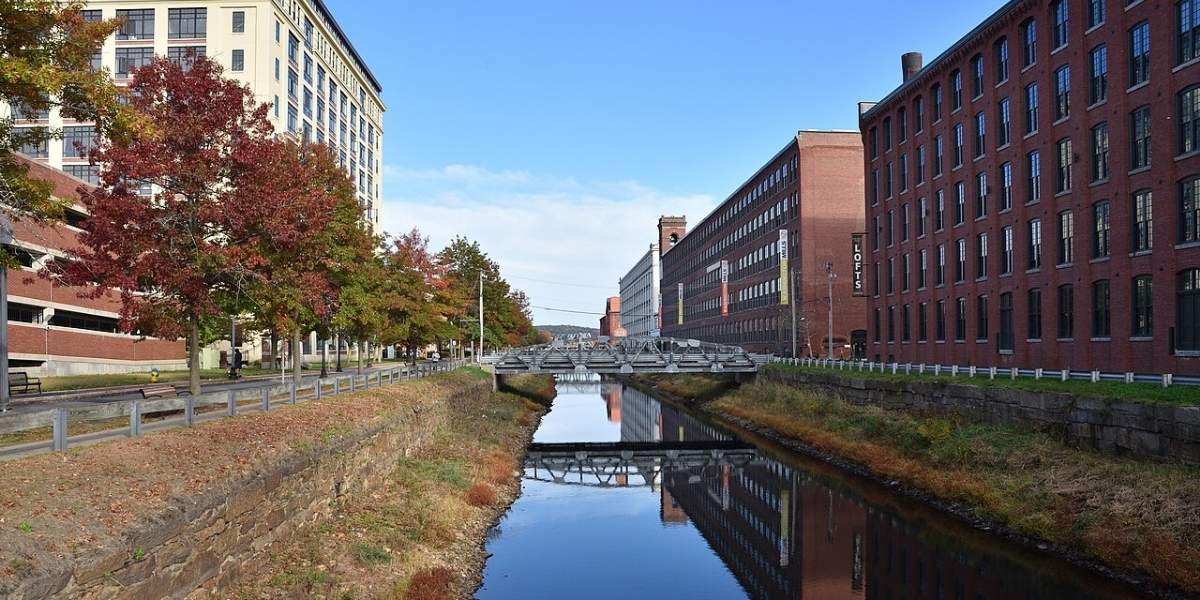
But it is also one of the state’s most important immigrant cities, a place packed with Dominican and Puerto Rican culture, family-run restaurants, old mill buildings, commuter rail access and residents who fiercely defend the parts outsiders never bother to see.
A Mill City With A Long Memory
Lawrence was built as a textile city, and its history still hangs over the place.
The city is best known nationally for the 1912 Bread and Roses Strike, when thousands of immigrant textile workers walked out over pay and working conditions.
The strike became one of the most important labor actions in U.S. history and helped cement Lawrence’s identity as a working-class immigrant city.
That legacy never really left.
Today, Lawrence remains one of Massachusetts’ major gateway cities for immigrants. The city had about 88,700 residents in 2024, according to Census data. More than 83% of residents identify as Hispanic or Latino, according to Data USA.
That culture shows up everywhere — in the bodegas, bakeries, barbershops, Spanish heard on the street and the food people cannot stop talking about.
The Food Might Be The City’s Best Argument
Even Lawrence’s harshest critics often pause before admitting one thing: the food slaps.
“FOOD. Seriously,” one commenter wrote. “The Dominicans and Puerto Ricans are great cooks. So are the Mexicans.”
Locals repeatedly mentioned Tripoli Bakery, Tacos Lupita, Caribbean Bakery, El Taller, Pikalo, Joy Empanadas and Dominican restaurants tucked into bodegas.
Another commenter said: “Order mangu with salami at a local bodega. It will change your life.”
That is not a tourism-board sentence. That is a person who has seen the light and it came with fried cheese.
The city also has a surprisingly wide range of small local spots, from Mexican restaurants to Dominican food to Vietnamese Buddhist temple visits that residents describe as unexpectedly welcoming.
For a city that gets talked about mostly through crime and school rankings, Lawrence’s food scene may be its most underappreciated civic asset.
The Schools Are A Major Concern
If there is one issue that comes up again and again, it is Lawrence Public Schools.
The district has been under state receivership since 2011, according to the Massachusetts Department of Elementary and Secondary Education. In 2026, the state appointed a new receiver, continuing a long-running intervention that has lasted more than a decade.
That is not a small footnote. It is a defining part of life for families considering Lawrence.
Several Reddit commenters, including teachers and parents, described deep frustration with the system.
“I was a teacher in Lawrence for a bit,” one person wrote. “There are a million reasons the retention is bad.”
Others offered a more balanced view. One former teacher said Lawrence students and families were among the best parts of the job.
“You will absolutely love the kids and the families,” the commenter wrote. “I still miss them.”
That tension appears often: people praise the children, families and community while criticizing the system around them.
The Reputation For Crime Is Real — But Complicated
Lawrence has a reputation as one of Massachusetts’ rougher cities, and residents do not exactly pretend otherwise.
Online discussions repeatedly mention drugs, property crime, aggressive driving, homelessness and gang activity.
One commenter described Lawrence as “a struggling city for New England.”
Another said the city has “a lot to love but also a lot to hate.”
But several residents pushed back against the idea that Lawrence is dangerous in the way outsiders imagine.
“It’s poor but the crime rate is surprisingly low for its rep,” one commenter wrote.
Another said much of the violence is not random.
“Yes things happen,” one person wrote, “but a lot of the violence is because of the things people get involved in. Not random crime.”
That distinction matters.
Lawrence is not Mayberry. But longtime residents say the city’s reputation can make outsiders imagine a level of random danger that does not match daily life for many people who live and work there.
The Drug Problem Casts A Long Shadow
The more serious concern residents raised was addiction.
Several commenters described Lawrence as a regional hub for fentanyl and other drugs. A travel nurse working at Lawrence General Hospital wrote: “The amount of overdoses are crazy.”
Those are individual accounts, not official findings. But the theme came up often enough to be impossible to ignore.
Like many former industrial cities, Lawrence has been hit hard by poverty, addiction and limited opportunity. The city’s poverty rate was 17.6% in 2024, higher than Massachusetts overall, according to Census data.
That economic reality shapes nearly every conversation about the city.
Housing Is “Cheap” Only By Massachusetts Standards
One reason people still look at Lawrence is simple: Massachusetts is expensive, and Lawrence is less expensive than many surrounding communities.
That does not mean Lawrence is actually cheap.
Zillow estimated the average home value in Lawrence at about $516,000 in 2026. Redfin reported a median sale price near $596,000 for the three months ending in May 2026.
So yes, Lawrence may be more affordable than Andover, Reading, Cambridge or much of Greater Boston.
But “affordable” is doing some Olympic-level stretching here.
Still, compared with neighboring towns, Lawrence can offer lower rents, older housing stock, commuter rail access and dense neighborhoods that work better for people without cars.
As one commenter put it: “It has a commuter rail stop.”
Not exactly poetry. But in Massachusetts housing math, that is a love language.
The City Has Real Assets
For all the criticism, Lawrence has more going for it than its reputation suggests.
Residents pointed to:
- the commuter rail;
- the Merrimack Valley Regional Transit Authority;
- Northern Essex Community College’s Lawrence campus;
- old mill buildings and lofts;
- the New Balance factory store;
- parks and the reservoir;
- community theater;
- beautiful churches;
- the antique store on Canal Street;
- and easy access to New Hampshire.
One commenter summed up the positive side well: “The town is just so resilient.”
That may be the most generous and accurate description of Lawrence.
It has been a landing place for generations of immigrants. It has survived industrial decline, poverty, political dysfunction and the 2018 Merrimack Valley gas explosions, which killed one person, injured others and damaged homes and businesses across Lawrence, Andover and North Andover.
Lawrence has taken a lot of punches. It is still standing.
The Driving, Though? Good Luck.
If food is the city’s great unifier, driving may be its comic relief.
Several commenters complained about Lawrence drivers with the kind of detail that suggests emotional scarring.
“They won’t turn right on red,” one person wrote. “But they’ll drive straight through a red light.”
Another said drivers will “create their own lane.”
A third warned that pedestrians “just walk right out into the road without looking.”
This is not official traffic analysis. It is better. It is the sound of people who have survived a left turn in Lawrence and lived to post about it.
So What’s It Really Like Living In Lawrence?
According to residents, Lawrence is not one thing.
It is poor, proud, loud, dense, resilient, frustrating and full of flavor.
It has serious challenges: schools, addiction, public safety concerns, poverty and city management complaints.
It also has deep community ties, immigrant history, strong families, great food, transit access and more heart than outsiders often give it credit for.
For some people, Lawrence is a place to avoid. For others, it is home.
One commenter captured the city’s contradictions better than any statistic could: “There’s a lot wrong with Lawrence but it’s not terrible in absolute standards. It’s better than a lot of places elsewhere in the U.S.”
That may not sound like a glowing endorsement.
But for Lawrence, it might be the most honest one.